
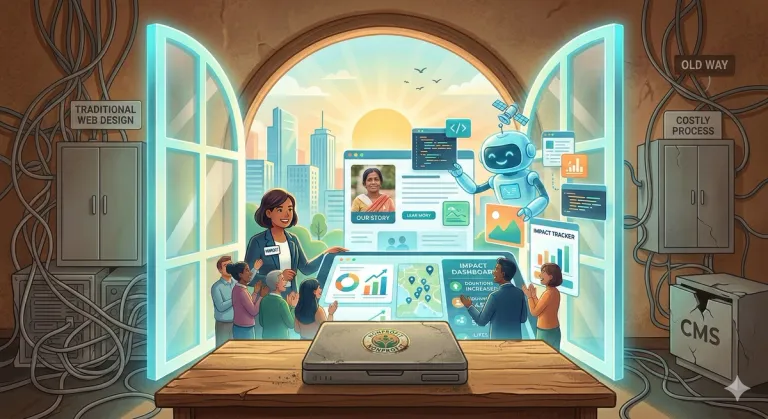
Something has changed.
If you lead a nonprofit, you already know how important it is to demonstrate your impact. Board members need to see evidence that programs are working. Donors want confidence that their dollars are making a difference. And the communities you serve deserve to see the story of what you're accomplishing on their behalf. None of this is new.
What's new is that building the technology to do this well is no longer out of reach.
For years, the gap between what nonprofits needed their websites to do and what they could actually afford was enormous. You wanted a site that could surface program outcomes, tell beneficiary stories backed by real data, and give your board something more compelling than a spreadsheet at the next quarterly meeting. But what you typically manifested was a digital brochure — a few pages about your mission, a donate button, and maybe a blog you updated, what, twice a year?
Why It Used to Cost So Much
There are plenty of reasons why building and maintaining an effective website has been expensive. Let me give you a flavor of the practical differences between today and, say, six months ago.
The traditional web design and development process requires everyone to agree on everything upfront. Every piece of content your site will display has to be anticipated, mapped out, and built into a content management system before you ever see a working page. That means defining database fields, designing content structures, and hoping you think of everything. Of course, nobody ever thinks of everything.
Every change — a new program to highlight, a different way to slice your impact data, an additional reporting metric your board requested — has meant going back through multiple layers of infrastructure. Frontend design changes cascade into backend changes. A simple request to add a new data point can trigger days, if not weeks, of development work.
This process, now completely outdated, causes costs to pile up quickly, and for organizations already stretched thin, the math just doesn't work.
What's changed?
A more efficient process
AI has fundamentally flipped the web development process. Instead of spending weeks defining your content structure before seeing a single page, we now start with your data — whatever you have, however it's organized — and begin generating a frontend that displays it beautifully so that you can actually SEE it and provide feedback immediately. We iterate on that design until it's exactly right. Add new data points? Change the page structure? Reorganize your navigation? All of that happens quickly and affordably at the design level. It also happens in code, so that you can actually see how it behaves in a browser. You can touch it and stretch it and smell it. (Just seeing if you're paying attention here)
That rapid prototyping is only half the picture. The other half is keeping the presentation layer and the content layer separate from the start. Your data gets modeled the way your organization actually thinks — programs, outcomes, beneficiaries, funding streams — not reshaped to fit whatever the homepage happened to need that week. The website tells the story; the content system holds the truth. And because AI now accelerates work on both sides, changing either one is no longer a weeks-long slog of wrestling frontend code against backend structures. Want a new way to surface impact for the board? Adjust the presentation. Need to track a new grant metric? Extend the model. Those are independent moves, and both are far more practical than they used to be.
Even after launch, changing designs, content, and content structure remains straightforward. We're no longer locked into decisions made months ago by people guessing about what you'd eventually need — and we're not locked into a frontend that dictated how your data had to be organized in the first place. The technical constraints have been removed. To me it feels akin to when you get several overcast days in a row, and then all of a sudden you wake up and the sun is shining, there's a crispness to the air, and the birds are singing. I'm perhaps a little passionate about this stuff.
Technical complexity has less impact on overall project costs
In ancient times, last year, a small increase in complexity of a coding task would generally lead to a disproportionate increase in time (ahem… cost) required to complete the task. Let's take consuming APIs as an example. APIs have become both more accessible and less expensive to consume. Modern platforms — from donor management tools to program tracking databases — now offer well-documented, affordable integrations. Even so, as anyone who has dealt with integrating systems through APIs knows, no matter how modern they may have become, they still aren't exactly a playground for the timid. Thanks to AI and its spectacular ability to deal with the intricacies of interfacing with systems at the API level, however, pulling live data from your operational systems into your website is no longer a six-figure custom development project. It's a realistic, affordable component of a well-built site.
What All This Means for Your Organization
Your website can now do what you've always needed it to do.
Externally, it becomes your most powerful tool for building community trust and donor credibility. Impact dashboards that update with real data. Program pages that show measurable outcomes alongside the human stories behind them. A living, breathing demonstration of your effectiveness that's always current and always accessible.
Internally, that same infrastructure gives your leadership team and board real visibility into what's working and what isn't. Instead of assembling reports from scattered spreadsheets before every board meeting, your data lives in one place, presented clearly, and available on demand. That's not just more efficient — it actually helps you make better strategic decisions about where to focus your resources.
The Window Is Open
This isn't a theoretical future. The technology exists today, and the economics finally make sense for organizations of every size. The nonprofits that move now will have a significant advantage — not just in how they present themselves to the world, but in how well they actually understand their own effectiveness.
At Digett, we've spent over two decades building websites for organizations that need to communicate their value clearly and compellingly. We understand that for nonprofits, a website isn't a marketing luxury — it's mission-critical infrastructure. And for the first time, building one that truly serves your mission is within reach.
If you're ready to explore what's possible, we'd love to talk.